
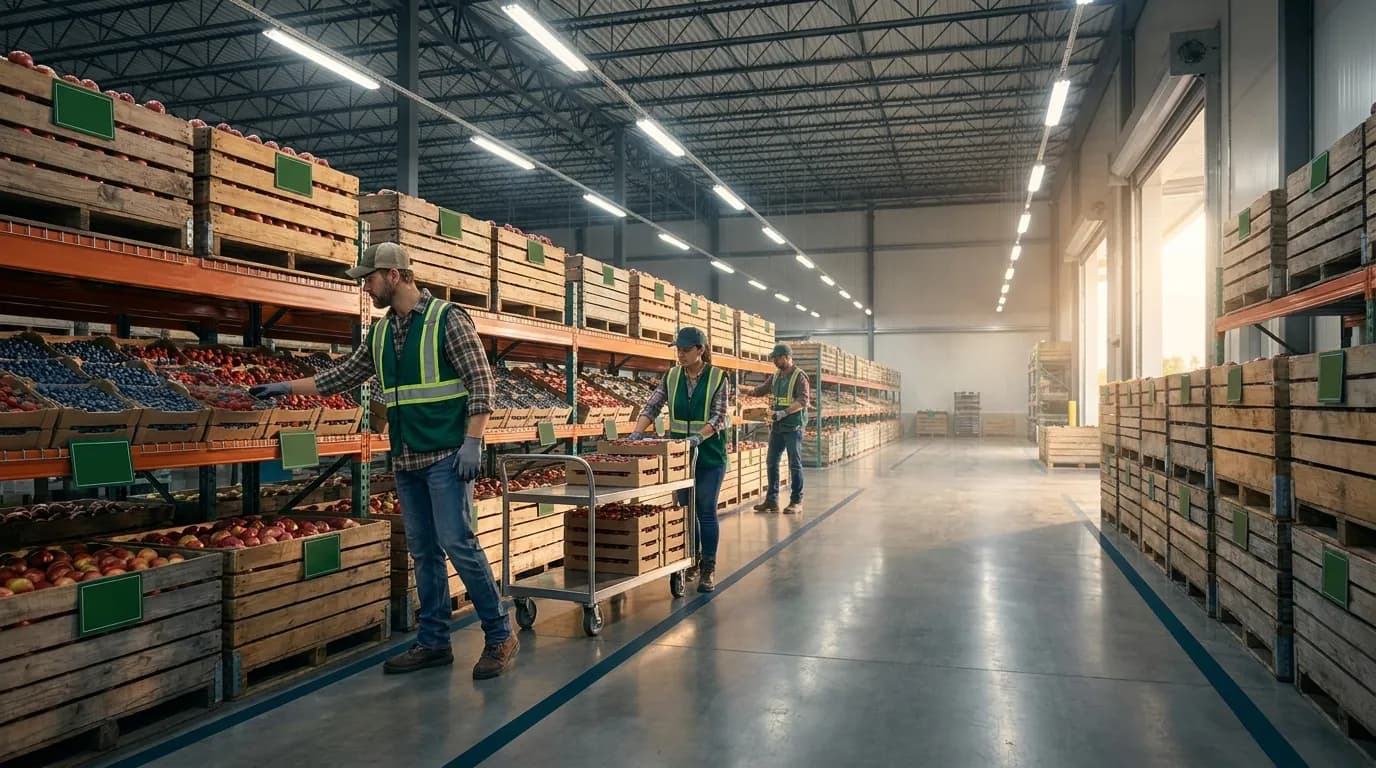
How Does Piece Rate Pay Work on Harvest and Field Crews?
Under piece rate pay, a worker earns money for each unit of work finished instead of, or on top of, each hour on the clock. Farm units are usually physical and easy to count: a bin, a lug, a tote, a flat, a pound, a tree or a row. A picker's gross piece earnings for the week equal the units completed multiplied by the rate attached to that unit.
Basic formula: Piece earnings = units completed × rate per unit
That is where the simplicity ends. Many crews mix hourly and piece work in one week. A crew might be paid hourly to set up irrigation on Monday and then paid by the bin for picking Tuesday through Saturday. Rates can change by crop, variety, block or fruit quality. Federal and state rules also require employers to test piece earnings against minimum wage and, in some states, against overtime and rest-period obligations. The DOL Wage and Hour Division agriculture page is the right starting point for federal requirements. For a wider view of how payroll fits into farm systems, see our agribusiness software guide.
Common Piece Units: Bins, Lugs, Flats, Pounds, Trees and Rows
The unit you pick shapes your recordkeeping. Tree-fruit operations often pay a set amount for each bin of apples or pears, sometimes split among a team that fills it together. Vineyards commonly pay per lug or tote of wine or table grapes. Berry farms pay by the flat or by the pound, with weights captured at a scale. Pruning, thinning and tying crews may earn a fixed amount for every tree, vine or row they finish.
Each unit raises its own counting question. Team-filled bins need a documented method for dividing credit among pickers. Pound-based pay depends on accurate scale weights. Row rates should account for rows that differ in length and density from block to block. Whatever the unit, every count needs to be tied to a specific worker or crew, a date and a location. That way it can support both the paycheck and later labor cost reporting.
Why Growers Use Piece-Rate Wages
The reasons are practical. During harvest, fruit quality and timing matter, and paying by output rewards the pace a short window demands. Experienced pickers often prefer it because skilled workers can out-earn an hourly rate. Managers also get a predictable cost per unit harvested, which helps when budgeting a block or comparing crops.
Some growers pair a base unit rate with a quality bonus, for example a premium per bin when bruising stays below a set level at the packing shed. That discourages rushing at the expense of fruit condition, but it also adds another earnings line that has to flow into every weekly test, including the overtime calculation wherever overtime applies.
Output-based pay can help recruiting in competitive seasons, too, since crews talk about which farms pay well. The trade-off is administrative. The employer must confirm that wages meet every applicable legal floor, each week, for each worker, including seasonal and H-2A crews where those programs apply.
Where Piece Rate Pay Gets Complicated in the Field
Most problems start out in the rows, not in the office. Crews move between blocks during a day, sometimes onto another crop with a different rate. Workers wait for bins, travel between fields, attend safety meetings or sit out equipment breakdowns. That nonproductive time still counts as hours worked under many rules, and some states require it to be paid separately.
Record gaps are the other big pain point. A tally sheet that shows bins but not hours, or hours but not the block, makes minimum-wage compliance hard to prove and accurate labor costing impossible. Mixed weeks add another layer, because both pay types and all hours must be combined for the weekly checks covered below.
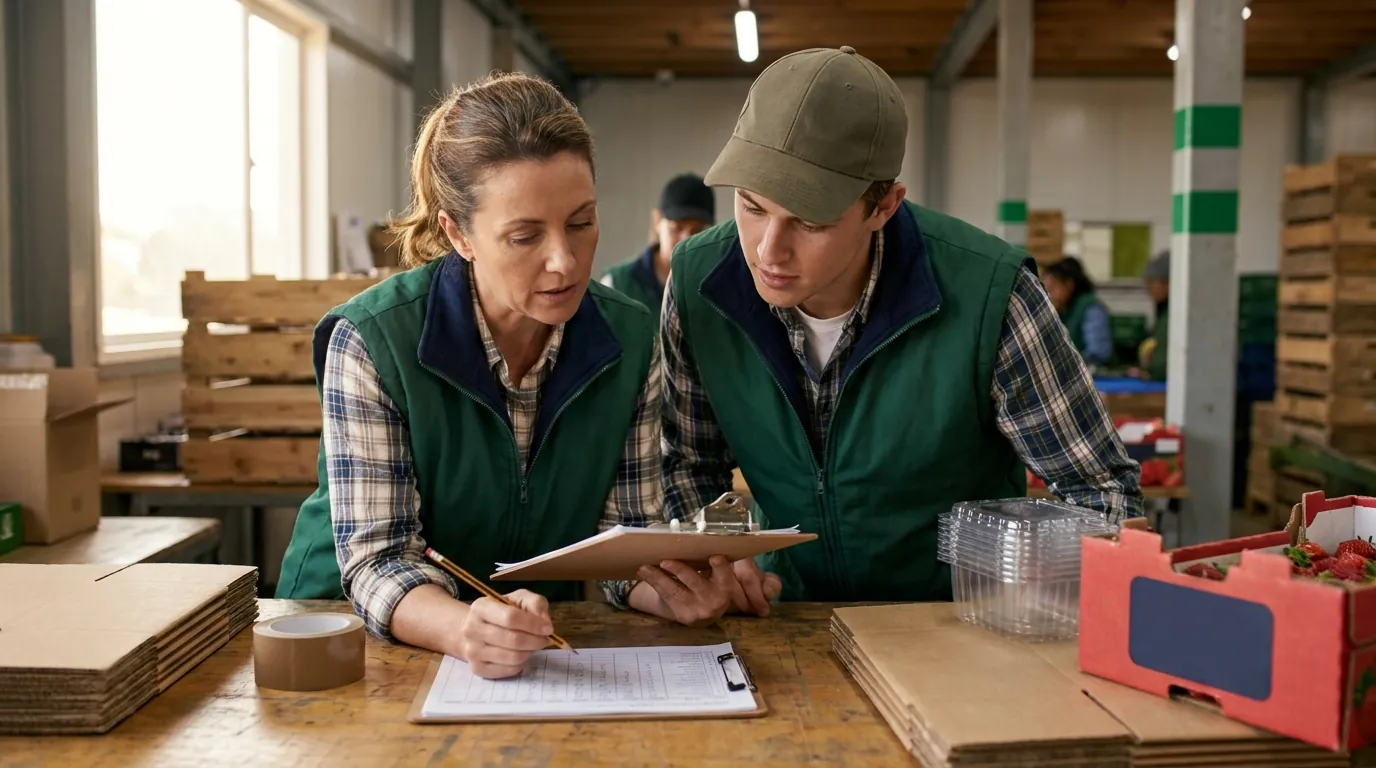
Minimum-Wage Make-Up for Piece-Rate Crews
Under the federal Fair Labor Standards Act (FLSA), covered piece-rate workers must earn at least the applicable minimum for every hour worked. The federal test runs on a workweek basis: total the week's earnings, divide by total hours, and compare the result to the minimum. When the effective hourly rate falls short, the employer pays the difference, usually called a make-up payment.
Federal make-up check (workweek basis): Effective rate = total weekly earnings ÷ total hours worked. If the effective rate is below the minimum, make-up = (minimum × total hours) minus total earnings.
Two cautions apply. First, hours must include all time worked. Travel between blocks, waiting for bins and required safety meetings all count, not just picking. Second, some states restrict weekly averaging or require separate pay for certain nonproductive time, so a federal-only calculation may not be enough. Check your state labor department's guidance before relying on the workweek method.
Is Your Operation Covered by the Federal Minimum Wage?
Agriculture has its own FLSA coverage tests. DOL Fact Sheet #12 explains that some smaller farms may be exempt based on the man-days of agricultural labor used in calendar quarters of the prior year. Certain workers, such as some immediate family members and some hand-harvest piece-rate workers meeting specific conditions, may also be exempt. These exemptions are narrow and fact-specific. They do not override state minimum-wage laws or H-2A contract obligations, so confirm your status with the agency or counsel instead of assuming one applies.
Hypothetical Make-Up Walkthrough: A Week of Grape Lugs
These figures are illustrative only, not current rates for any jurisdiction. Assume a hypothetical minimum of $15.00 per hour and $1.30 per lug. Here is how three pickers come out at the end of the week:
- Picker A picked 520 lugs for $676.00 over 40 hours, an effective $16.90 per hour, so nothing extra is owed.
- Picker B filled 400 lugs worth $520.00 in 40 hours. That works out to $13.00 an hour, which leaves a shortfall against the floor.
- Picker C brought in 450 lugs ($585.00) across 38 hours, averaging $15.39, which clears the minimum.
Picker B's make-up is ($15.00 × 40) minus $520.00, or $80.00, bringing weekly pay to $600.00. Picker C's 38 hours include time spent waiting for empty lugs. Dropping those hours would inflate the effective rate and could hide a shortfall. Picker A's numbers need no adjustment, and Picker C clears the floor only because every hour, including the waiting, was logged and tested honestly.
Assigning crews to blocks in planned rounds, much as a warehouse groups orders in wave and batch picking, keeps idle time visible instead of buried. Whatever system you use, keeping lugs and hours in the same record means both figures are already there when someone runs the weekly check, rather than being pieced together from separate tally sheets and time cards.
When State or H-2A Wage Requirements Are Higher
The federal minimum is a floor, not the number most growers actually test against. Many states and some localities set higher minimums, and employers generally must meet the highest rate that applies.
H-2A employers carry their own obligation. DOL program materials describe a required wage that is generally the highest of several rates, including the Adverse Effect Wage Rate (AEWR) and applicable prevailing, agreed-upon and legal minimum rates. That obligation extends to workers in corresponding employment. AEWRs change, so pull current figures from the DOL Office of Foreign Labor Certification and WHD H-2A pages each season rather than reusing last year's number. H-2A rules also set specific requirements for unit-based pay, covered further below.
How to Calculate Overtime Pay for Piece-Rate Farmworkers
Overtime is where farm piece wages depart furthest from the general FLSA picture. Before running numbers, confirm whether any overtime rule covers your crews at all, which depends heavily on your state. Where one applies, a picker has no fixed hourly wage to multiply by 1.5, so federal regulations describe two computation methods, and many state agencies follow similar logic with their own variations. The examples below illustrate arithmetic only. They do not say when overtime applies in your state or at what threshold.
Does Overtime Apply to Your Farmworkers?
Federal law exempts employees employed in agriculture from FLSA overtime, as DOL Fact Sheet #12 explains. Fact Sheet #23 covers general federal overtime rules.
Several states have adopted their own farmworker overtime laws, including California, Washington, New York, Oregon and Colorado. Thresholds, phase-in schedules, small-employer timelines and calculation details vary and keep changing, so check with the agency in your state (for example California DIR, Washington L&I or Oregon BOLI). H-2A job orders can also carry their own terms.
Method 1: The Regular Rate Method (29 CFR 778.111)
A piece worker's weekly regular rate equals total earnings from piece rates and every other compensable source (production bonuses, pay for hourly or nonproductive work) divided by total hours worked. Because straight-time pay for all hours is already inside those earnings, the worker is owed an extra half of that rate for each overtime hour.
Formula: Regular rate = (piece earnings + bonuses + other pay for hours worked) ÷ total hours. Premium = 0.5 × regular rate × overtime hours.
Hypothetical example, assuming a 40-hour threshold that is not any state's actual rule: a picker fills 36 apple bins at $24.00 each ($864.00), works 2 hourly orchard hours at $18.00 ($36.00), and logs 48 hours total. The rate is $900.00 ÷ 48 = $18.75. Premium = 0.5 × $18.75 × 8 = $75.00, for total pay of $975.00.
Method 2: 1.5x the Piece Rate by Prior Agreement (29 CFR 778.418)
If employer and employee agree before the work is performed, section 778.418 allows paying at least one and one-half times the piece rate for pieces produced during overtime hours. The rate must be bona fide, and compensation must still meet minimum wage for all hours.
Hypothetical example: at $1.30 per lug, a worker picks 520 lugs in the first 40 hours ($676.00) and 90 lugs in 6 overtime hours at $1.95 ($175.50). Combined, that is $851.50 for 46 hours, or roughly $18.51 per hour, which sits above the hypothetical $15.00 floor used earlier.
This approach requires timing records that show which pieces came after the threshold. Some states may not recognize it, so confirm before adopting it.
Common Overtime Mistakes on Piece-Rate Crews
- Paying 1.5x a base wage instead of computing the true regular rate.
- Leaving production or quality bonuses out.
- Excluding hourly, nonproductive or rest-period pay.
- Counting only picking time and missing travel, waiting or meeting time.
- Using the 1.5x piece method without a documented advance agreement.
- Averaging hours across workweeks.
- Applying another state's threshold or an outdated schedule.
- Running overtime math before the minimum check is done.
Most of these errors trace back to how hours and pieces get recorded. A payroll process that captures each worker's units and time together, tagged by task and location, removes much of the end-of-week guesswork. Nursery operators face the same records problem, covered in our review of plant nursery management software.
Rest and Recovery, Nonproductive Time and H-2A Considerations
Minimum wage and overtime are only part of the review. Some states require crews paid by the piece to receive separate compensation for rest breaks and for minutes spent not producing, instead of treating bin or tray earnings as covering that time. Wage statement content, payroll records and H-2A program terms add further obligations for growers.
This part stays general on purpose. The calculation methods come from statute and agency guidance, they vary by jurisdiction, and errors can create back-pay exposure. Treat the official sources named below as your reference.
Disclaimer: This article is general information for agricultural employers and is not legal advice. Pay rules change and depend on your location, workforce and facts. Confirm current requirements with the US DOL Wage and Hour Division, your state labor agency and qualified employment counsel before setting pay practices.
States That Require Separate Pay for Rest and Nonproductive Time
California is the best-known example. Labor Code section 226.2, added by AB 1513, requires employers to compensate piece-rate employees separately for rest and recovery periods and other nonproductive time, and it sets out how those periods are paid and itemized. The Department of Industrial Relations (DIR) and its Labor Commissioner's Office publish FAQs on the topic. Read the statute and DIR guidance directly rather than relying on a summary formula.
Washington has also addressed this issue, and its Department of Labor and Industries (L&I) publishes guidance on paying agricultural piece workers for breaks. Other states may have their own rules or court decisions, so a grower with orchards or fields in several states should check each one.
Wage Statements and Recordkeeping Expectations
Federal rules require accurate payroll records, and DOL agricultural guidance describes what farm employers must keep. For piece workers, that generally means hours worked each day and week, units produced, rates paid and total earnings. California's section 226.2 also lists items that must appear on itemized wage statements, and H-2A rules set their own earnings statement requirements.
Investigators tend to ask one question: can the employer show, worker by worker and week by week, units produced, hours worked and how pay was calculated? Gaps in any of those three are where risk builds. Operationally, the answer is a single daily record per worker that holds units, time, block and task, kept in a form that can be pulled up months later. Growers running nursery or greenhouse crews can compare related criteria in our review of the best software for greenhouse management.
H-2A Program Obligations in General Terms
Growers and farm labor contractors using H-2A workers take on obligations set out in DOL regulations at 20 CFR part 655, subpart B, which WHD enforces. In general terms, these include paying at least the required wage rate, which DOL describes as the highest of several rates including the AEWR; meeting the three-fourths guarantee of hours offered; providing housing, transportation and meals as specified; keeping detailed records; and furnishing earnings statements. The regulations also address piece-rate compensation directly, including making sure piece earnings meet the required hourly wage.
These obligations generally extend to workers in corresponding employment too. Review the DOL H-2A resources at dol.gov/agencies/whd/agriculture/h2a and confirm current AEWRs before each season.
Recording Pieces and Hours So Labor Cost Lands on the Field or Crop
Every wage check covered so far rests on two figures for each worker each week: pieces and hours. Make-up calculations need every hour on the clock. Overtime needs total earnings alongside that time. Rest and nonproductive pay, where a state requires it, needs those periods identified separately. If either figure is missing or credited to the wrong person, the math breaks.
Those same records answer a question growers ask every season: what did it really cost to harvest this block? When those counts and times carry crew, location and task details, payroll becomes cost data instead of a compliance chore. A make-up payment on a slow-picking block, overtime during a rush on one variety, or idle time waiting on bins each becomes a visible cost attached to one field. The aim is to record the work once, in enough detail to serve both pay and accounting.
Why Crew, Block, Cost Center and Activity Matter
Treat each line of labor data as needing four tags. Crew or individual says who did the work and whose wage checks it feeds. Block or field says where it happened. Cost center and account say where the expense posts in your books. Activity separates picking from pruning, thinning, irrigation setup or travel.
Skip the activity tag and nonproductive time hides inside picking time. Skip the block tag and a crew that moves from Honeycrisp to Gala mid-afternoon gets charged to one variety. Skip attribution to a person or crew and make-up and overtime cannot be figured correctly. Capturing all four close to the job, even on paper tallies transcribed daily, cuts the end-of-week reconstruction where most errors start.
Consider a hypothetical Thursday. A crew of twelve picks Gala in Block 4 until noon, waits 40 minutes for a bin trailer, drives to Block 7 and finishes the day thinning peaches. Tagged properly, that one day produces at least four lines: Gala picking in Block 4, waiting time, travel, and peach thinning in Block 7. Each line feeds a different part of the wage check and lands in a different cost bucket.
How Argos Software Supports the Workflow
Farm payroll in Argos Software is organized around crew-level labor data. The farm management solution page states that the system "allows labor hours and/or pieces to be entered for all employees by cost center, account, and activity," adding, "This can be by individual or by crew."
The farm management software industry page describes helping growers "Ensure compliance with labor laws, including H-2A and seasonal worker payroll requirements," and notes you can "Easily manage seasonal and full-time labor with automated payroll processing, time tracking, and benefits management." Related tools appear under human resources features.
The legal rules themselves (make-up methods, state overtime thresholds, rest-period pay) come from the DOL and state agencies, and your team remains responsible for setting up pay practices that match them.
Turning Payroll Data Into Labor Cost per Block and Crop
With labor recorded by cost center, account and activity, you can compare blocks on true labor cost, including make-up, overtime premiums and nonproductive pay, not just the posted rate.
Hypothetical example: two apple blocks both pay $24.00 per bin. Block 1 has strong yields and needs no make-up. Block 2 carries light fruit, so pickers fill fewer bins per hour, triggering minimum-wage top-ups and more waiting. The posted rate is identical, yet the effective cost per bin on Block 2 runs higher. That insight can shape next season's rates, crew assignments or replant decisions.
Growers who also sell plants can carry those costs into billing; see our look at plant nursery invoice software. To gauge how productively hours are used, read our guide to calculating labor utilization.
Bringing It Together for Your Next Harvest
Paying harvest and field crews by the bin, tote or pound works well, but the numbers only hold up when the weekly checks happen in the right order and nothing is missing from the underlying records. The principle stays the same from crop to crop: tie every piece and every hour to an employee or crew, a block and an activity. Then test the totals against each pay rule that covers your farm.
Those rules change. Federal agricultural exemptions, state farmworker overtime schedules, break-time pay requirements and H-2A wage rates differ by location and are revised over time. Before each season, and any time your state announces a change, confirm the current requirements with the federal WHD, the DOL's H-2A program pages and the labor department in your state. Last year's spreadsheet is not an authority.
A short pre-season setup helps. Confirm the rate for every crop and block before the first pick, decide how team bins will be split, settle how waiting and travel will be logged, and make sure supervisors know which activity codes to use. Putting those decisions in writing before crews arrive is far easier than untangling them in the middle of a heavy week.
A Weekly Piece Rate Pay Routine for the Office and the Field
Treat the steps below as a general framework and adjust them to the rules in your state:
- Capture units and time every day by individual or crew, with block, cost center and activity. Include travel, waiting and meeting time, since those hours may count as hours worked under the rules that apply to you.
- Build each worker's weekly total: piece earnings, any hourly pay, bonuses and all hours worked.
- Test against the minimum. Compare earnings to the highest rate that applies (federal, state, local or H-2A), using the calculation method your jurisdiction requires, and pay any make-up owed.
- Add overtime where it is required, using the regular rate method or a properly agreed 1.5x piece rate, if your rules permit that approach.
- Pay rest breaks and idle time separately where state law calls for it, and itemize those amounts on wage statements.
- Allocate the full cost to field, block and crop, including make-up and overtime premiums, so a low-yield block shows what its labor really cost.
- Keep records that let anyone reconstruct how each paycheck was calculated.
The order matters. Running the minimum check before every hour is in, or allocating cost before premiums are added, produces numbers that look finished but are not.
On the office side, the Argos farm management software page describes crew-level entry of pieces and time, the kind of shared record that steps 1 and 6 depend on for both payroll staff and the field manager. The platform is also described as a way to manage seasonal and full-time labor with automated payroll processing and time tracking. Your payroll staff and advisors still decide which wage rules apply and how to interpret them.
Request a Demo to see how Argos Software handles crew labor entry for your operation.