
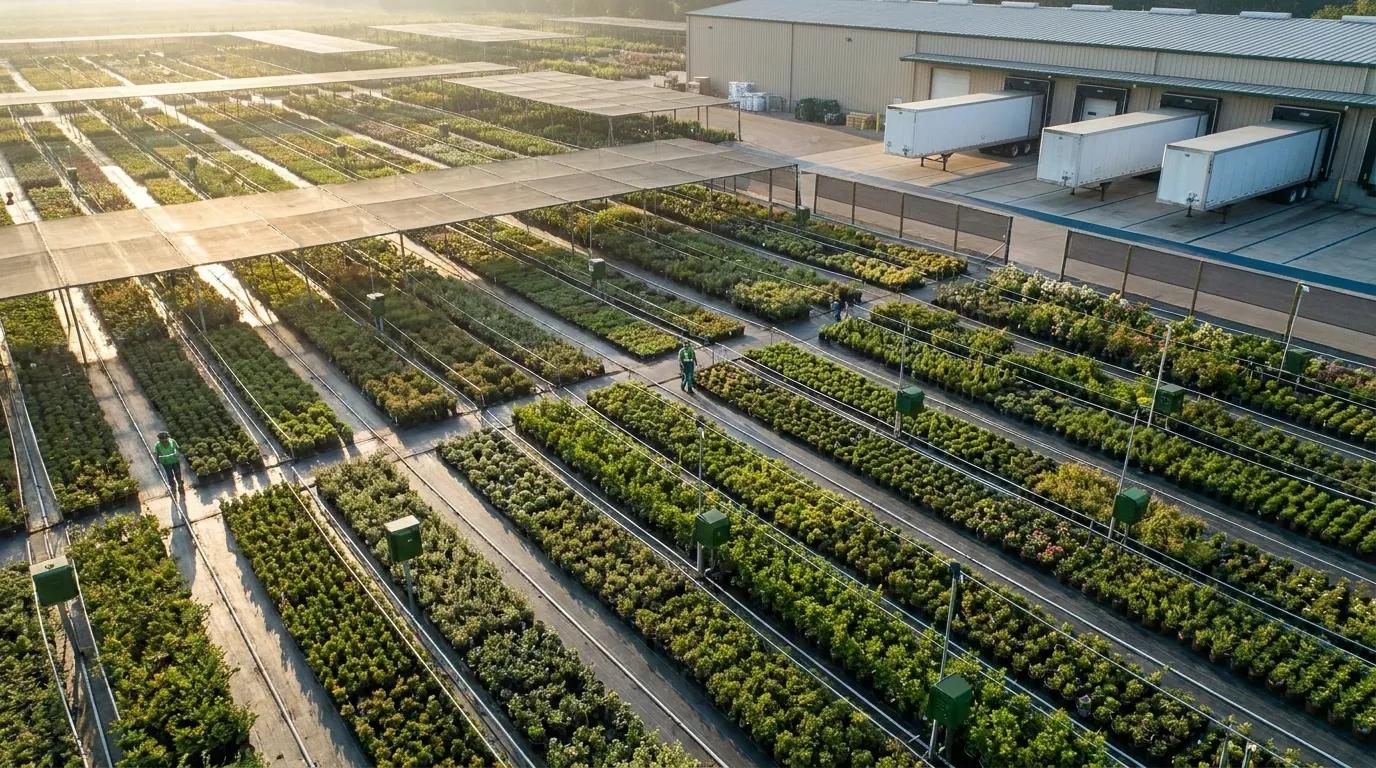
Why Greenhouse Growers Need Precision Agriculture Tools
Controlled environment agriculture (CEA) and greenhouse operations face pressure from every direction. Labor is harder to find and more expensive. Energy and input costs swing from season to season. Retail buyers increasingly expect traceability by lot on demand. Precision agriculture software for greenhouses addresses those pressures by turning sensor readings and production records into decisions growers can act on and records buyers can trust. The USDA Economic Research Service reports that H-2A positions certified for temporary agricultural workers have grown sharply over the past two decades, a clear signal of how tight the farm labor market has become.
Regulation is also raising the bar. The FDA Food Traceability Rule (FSMA Section 204) covers many greenhouse staples, including leafy greens, fresh herbs, tomatoes, peppers, and cucumbers. It requires Key Data Elements to be recorded at Critical Tracking Events such as harvesting, cooling, packing, and shipping. The FDA has proposed extending the compliance date to July 2028, but many buyers are already asking suppliers for this information.
The Hidden Cost of Siloed Greenhouse Data
When climate readings sit in one system, production plans in a spreadsheet, and inventory in another tool, every decision requires manual reconciliation. Common symptoms include:
- Head growers re-keying harvest counts into inventory at the end of a shift
- No link between a climate excursion and the lots it affected
- Traceability requests that take hours instead of minutes
- Shrink in coolers that nobody can trace back to its cause
The FAO estimates that roughly 13% of food is lost between harvest and retail, a major part of global food loss and waste. For greenhouse growers, much of that risk sits in handling and storage after the crop leaves the house, exactly where disconnected records hide problems.
What Greenhouse Precision Software Actually Does
Software in this category collects data from sensors, controllers, and people, then turns it into targeted decisions for each zone, crop, and lot. It applies the right input, in the right place, at the right time, and records the result so the team can learn from it next cycle.
The business outcomes growers should expect include:
- Yield consistency: tighter control of climate and fertigation by zone
- Input savings: water, nutrients, and energy applied based on measured need
- Reduced shrink: earlier detection of disease, storage, and cold-chain issues
- Faster traceability: lot records built automatically from harvest to shipment
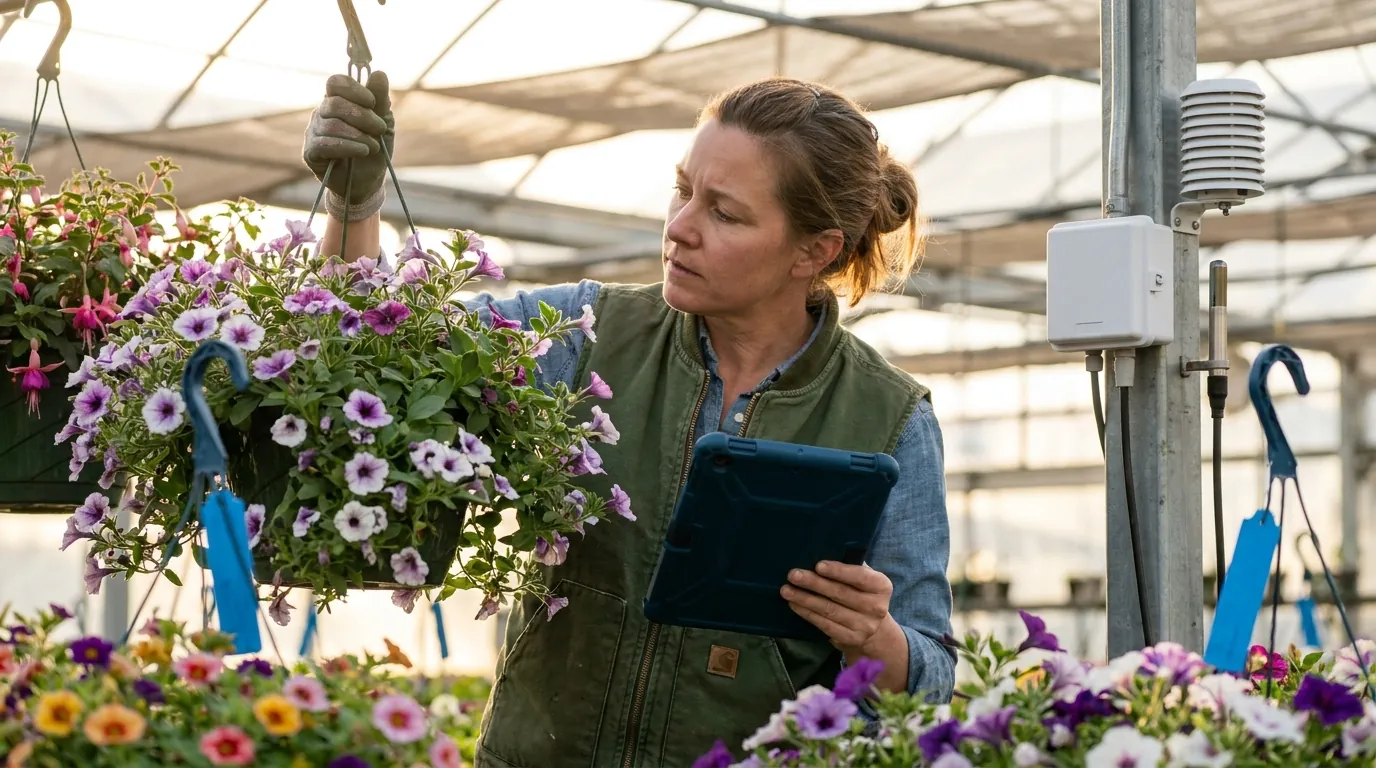
Precision Agriculture vs. Smart Agriculture vs. IoT in Agriculture
These three terms are often used interchangeably, but they describe different layers of a modern greenhouse operation. Using them precisely helps teams scope projects and compare vendors on equal terms.
- The connected device layer (IoT) is the network of sensors, controllers, and devices that measure and transmit data, such as a substrate moisture probe reporting every five minutes.
- Precision agriculture is the practice of using that data to make site-specific decisions, such as adjusting irrigation for one bench rather than the whole house.
- The smart, connected operation is the end-to-end business where data flows automatically from growing through packing, inventory, and sales, so the whole company responds to what is happening in the crop.
How the Three Layers Fit Together
Think of IoT as the data layer, precision agriculture as the decision layer, and the smart operation as the connected result. Here is how each one shows up in a typical house:
- Connected devices (IoT): measure and transmit conditions, for example CO2 and PAR sensors mounted in each bay. Facilities or IT staff typically own this piece.
- Precision agriculture: acts on readings by zone or lot, for example a zone-specific fertigation recipe. The head grower is normally responsible here.
- Smart, connected operation: sensor-to-sale integration, for example climate readings tied to a lot, a cooler position, and a customer order. Operations managers and leadership hold accountability at this level.
Most greenhouses already have parts of the first layer: a climate computer, a few probes, maybe a weather station on the roof. The value gap is usually in connecting the decision layer to the business systems that manage inventory, traceability, and fulfillment. A house can have excellent sensors and still lose money if nobody can see which lots were exposed to a heat spike, or which of those lots are now sitting in the cooler waiting to ship.
How IoT in Agriculture Works Inside the Greenhouse
The path is simple: sensors measure conditions, a network carries the readings to a gateway, software processes the data at the edge or in the cloud, and the results drive controls and business records. Each layer involves choices that affect cost, reliability, and how easily information reaches your ERP.
Greenhouses present specific challenges. High humidity, metal structures, glazing, and dense crop canopies can interfere with wireless signals, so connectivity planning matters as much as sensor selection.
Essential Greenhouse Sensor Types
Most CEA operations rely on a core set of sensors:
- Air temperature and relative humidity: drive ventilation, heating, and vapor pressure deficit (VPD) management
- CO2: guides enrichment so plants get what they can use without wasting gas
- Light / PAR: measures photosynthetically active radiation to manage shade screens and supplemental lighting, often tracked as Daily Light Integral (DLI)
- Substrate moisture: informs irrigation timing by bench or zone
- EC and pH: monitor nutrient concentration and solution chemistry for fertigation
Additional sensors for leaf temperature, drain volume, and cooler temperature extend visibility into crop stress and post-harvest storage.
Connectivity, Gateways, and Edge vs. Cloud Processing
Each connectivity option has trade-offs. LoRaWAN offers long range and low power for battery sensors spread across large ranges. NB-IoT uses licensed cellular spectrum for low-bandwidth devices where carrier coverage exists. Wi-Fi suits high-data devices such as cameras placed near existing infrastructure, while cellular and 5G connect remote sites and mobile equipment.
Gateways aggregate sensor traffic and forward it onward. Edge processing handles time-critical tasks locally, such as closing vents when temperature spikes, so control continues during internet outages. Cloud processing handles historical analysis, dashboards, and integration with ERP, inventory, and shipping systems.
Greenhouse Technical Architecture at a Glance
A full stack has six layers, each with its own components and a key decision to settle before buying hardware:
- Sensors: temp/RH, CO2, PAR, moisture, EC/pH, and cooler probes. Decide on accuracy, calibration schedule, and durability in humid air.
- Connectivity: LoRaWAN, NB-IoT, Wi-Fi, and cellular/5G. Weigh range, power draw, bandwidth, and signal strength through structures.
- Gateways: LoRaWAN gateways and industrial routers. Plan coverage per house and build in redundancy.
- Edge: climate computers and local controllers. Determine what must keep running offline.
- Cloud: data platform, analytics, and dashboards. Settle data ownership, retention periods, and open APIs.
- Business systems: ERP, inventory, traceability, packing, and shipping. Define how sensor readings link to lots, orders, and costs.
The last layer is where most sensor-focused projects stop short, and it is where the business value is actually realized.
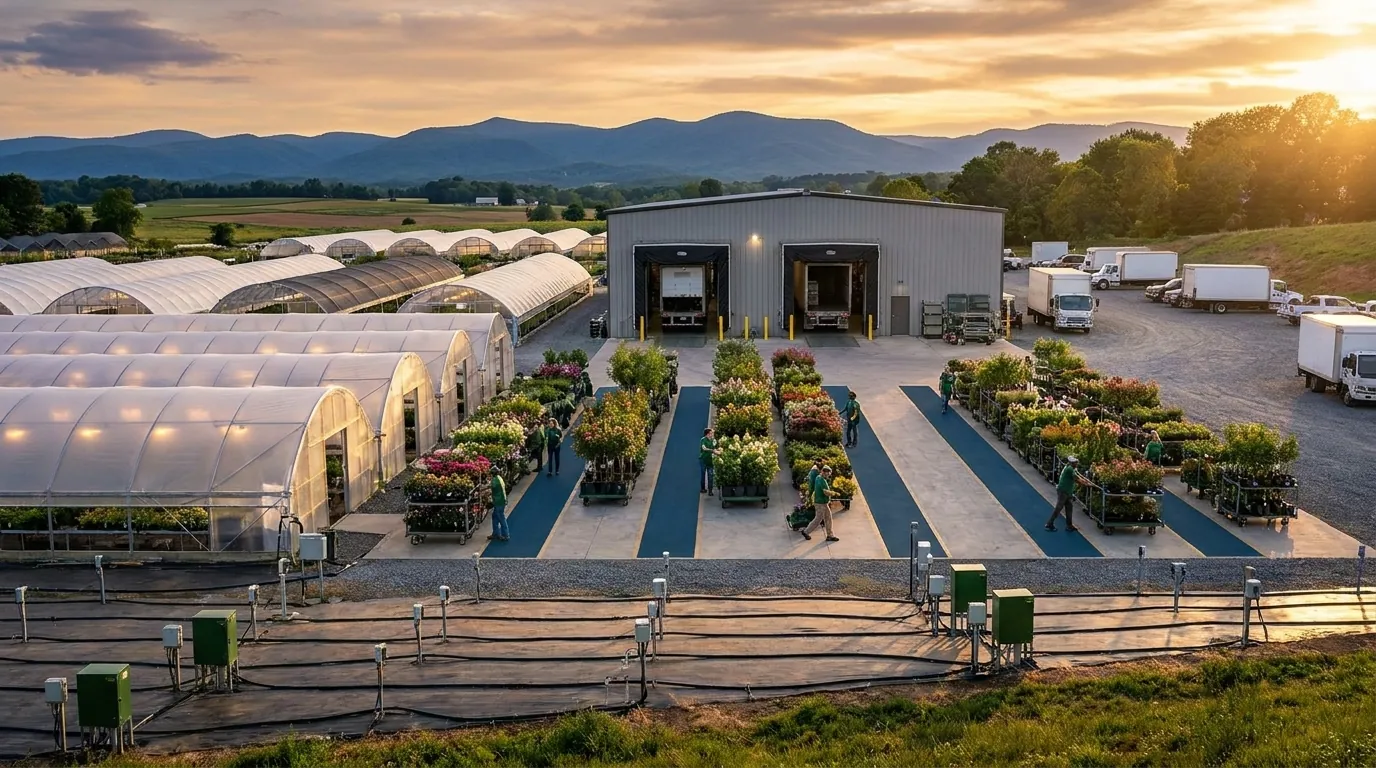
High-Impact Smart Agriculture Use Cases from Seed to Shipment
Connected operations deliver the most value when use cases span departments rather than living in one. The examples below follow the crop from propagation to the loading dock. The scenarios are illustrative and meant to show how data moves between systems, not to promise specific results.
Climate, Irrigation, and Fertigation Automation
Sensor-driven irrigation waters by measured substrate moisture instead of fixed timers, while EC and pH readings keep fertigation recipes on target. Consider a grower who notices drain EC climbing in one zone of a tomato house. She adjusts that zone's recipe and logs the change against the active production lot, so its effect on yield and grade can be reviewed after harvest instead of being forgotten.
Pest and Disease Early Warning
Sustained high humidity and leaf wetness create conditions for diseases such as botrytis. Software that flags these windows, combined with scouting records, lets teams act before an outbreak spreads. Linking alerts to lots also shows which harvests may need extra inspection on the packing line.
Yield Forecasting and Production Planning
Accumulated light, temperature, and historical yields can inform harvest forecasts. When forecasts feed production planning, sales teams can commit volumes to buyers with more confidence, and labor schedules can match expected harvest peaks rather than guesswork. A cloudy week that lowers DLI, for example, can push a forecast back a few days before customers are promised product that is not ready.
Lot-Level Traceability and Food Safety Compliance
Assigning a lot at harvest and carrying it through packing, storage, and shipping creates the records FSMA 204 requires. In a hypothetical recall, a grower can trace a shipment back to its zone, harvest date, and climate history, then identify every other order containing the same lot within minutes.
Cold-Chain, Post-Harvest Storage, and Inventory Tracking
Post-harvest is where many technology projects stop looking. Cooler and dock temperature sensors, linked to lot-level inventory, reveal when product sat outside its target range and for how long. Combined with first-expired, first-out rotation and real-time location tracking in the packhouse and warehouse, this helps reduce the post-harvest losses the FAO and USDA highlight as a major share of food waste. For a closer look at what lot-aware stock control should include, see this overview of plant nursery inventory software.
Implementation Roadmap: How to Choose and Deploy Precision Agriculture Software for Greenhouses
A successful rollout is a business project, not just a hardware install. The roadmap below keeps scope manageable, proves value early, and makes sure sensor readings reach the systems that drive revenue and cost. If you are still comparing broader platforms, our article on greenhouse management software covers operational features to weigh alongside sensor support.
The 5-Step Deployment Plan
- Audit current data and pain points. List every system, sensor, and spreadsheet in use, and identify where manual re-entry, traceability delays, or shrink occur.
- Define KPIs. Choose a few measurable targets, such as yield per square meter, water use per unit produced, shrink rate, or traceability response time.
- Pilot one zone. Deploy sensors and software in a single house or crop, establish a baseline, and compare results against a control area.
- Integrate with ERP, inventory, and shipping. Link sensor and production data to lots, cooler stock, packing, and orders so results show up in margin reports.
- Scale and train staff. Expand zone by zone, document standard procedures, and train growers, packers, and warehouse staff on the workflows they will use daily.
Evaluation Checklist for Greenhouse Platforms
Use these questions when comparing vendors:
- Interoperability: Does it offer open APIs and support your existing climate controllers and sensor brands?
- Scalability: Can it handle more zones, sites, and crops without re-architecture?
- Data ownership: Do you own your data, and can you export it in standard formats?
- Security: Are role-based access, encryption, and audit logs included?
- Traceability depth: Does it follow lots through packing, cold storage, and shipment?
- Inventory and fulfillment: Does sensor and production data connect to stock levels, orders, and invoicing?
- Support: Is there local or industry-specific help during implementation and after go-live?
Common Challenges and How to Address Them
- Connectivity dead spots: Conduct a site survey and add gateways where structures block signal.
- Upfront cost: Start with a pilot tied to one KPI so payback is measured, not assumed.
- Adoption: Involve head growers and warehouse leads early, and replace paper steps rather than adding new ones.
- Data overload: Focus dashboards on the few metrics each role needs to act on.
Turning Greenhouse Data into Profitable Decisions with a WMS
Sensors tell you what the crop is experiencing. An ERP or warehouse management system tells you what it means for the business. Once product leaves the growing area, a WMS can serve as the record of what happened next: which lots were received into the cooler, where each pallet sits, how long it stayed there, and which orders it shipped on.
When climate and crop records connect to that kind of backbone, growers can see how conditions in a zone affected the lots harvested there, how those lots held up in storage, and what they earned when they shipped. That is the difference between monitoring a greenhouse and running a profitable, connected growing business.
For teams evaluating precision tools, the key question is not only which sensors to buy, but where that information will live after the crop is cut, packed, and stacked in cold storage. The platform you evaluate should be able to capture lot numbers on receipts and shipments, show stock by location, and tie each sale back to the lot it came from, so sales, quality, and finance staff all work from one set of numbers rather than separate spreadsheets.
A practical test during any vendor demonstration is to pick one recent harvest and follow it end to end. Can the system show where that lot was stored, which customers received it, and what it invoiced at? If the answer requires exporting files and matching them by hand, the integration gap described at the start of this article is still there. Growers who manage nursery stock alongside greenhouse crops can also read how nursery inventory software supports agribusiness.
Request a Demo to see Argos Software in action.