
The Hidden Cost of Inconsistent Pricing: Why Pricing Schedules Matter
Pricing problems in logistics rarely arrive as one large loss. They arrive as dozens of small ones: a storage charge billed at last year's rate, a rush order handled without the expedite fee, a detention charge nobody captured. A logistics rate card is meant to prevent exactly these misses, but only if it is complete, current and connected to the work being done. Spread across 30 or 50 customers, each with its own contract, small misses can quietly erase several points of margin.
Spreadsheet-based pricing makes things worse. Rates get copied between files, sales reps quote from different versions, and billing staff re-key charges into the invoicing system. Every handoff is a chance for error. Each error becomes either lost revenue or a billing dispute that delays payment and strains the relationship with the customer.
What Does a Full-Service Rate Card Cover?
A full-service card is a structured, customer-specific schedule of charges for every service a provider performs. It typically covers warehousing (receiving, storage, handling, fulfillment and value-added services) and transportation (line-haul, fuel surcharge and accessorials). For each charge it defines the unit of measure, such as per pallet, per carton, per order, per hundredweight or per mile, along with minimums, effective dates and conditions.
When it is built well, this document becomes the one reference everyone trusts. Sales uses it to quote, operations uses it to know what is billable, and finance uses it to invoice. If you run a third-party operation, our 3PL logistics guide explains how these pricing agreements fit into the wider customer relationship.
Warning Signs Your Rate Cards Are Costing You Money
Watch for these symptoms:
- Invoices take days to prepare because charges are compiled by hand
- Customers regularly dispute line items or ask which rate applies
- Quotes for similar work vary depending on who prepared them
- Accessorial revenue stays flat even as service volume grows
- Nobody can say with confidence which contract version is current
If two or more sound familiar, your pricing structure needs attention.

Logistics Rate Card vs Transport Rate Card: How They Differ and Work Together
A transport-focused card covers just the movement of goods. It prices shipments by lane, zone, distance, weight break or equipment type, then layers on fuel surcharges and accessorials such as liftgate, inside delivery or detention. Carriers, freight brokers and fleet operators use it to rate full truckload (FTL, one shipper using the whole trailer) and less-than-truckload (LTL, multiple shippers sharing trailer space) moves.
The broader logistics version includes freight pricing as one component and adds the warehouse services that happen before and after each shipment. Consider a 3PL that handles a customer's inbound containers, storage, order fulfillment and outbound delivery. Its card ties every one of those charges to a single customer agreement.
The two have to work together. If storage and handling are billed from one system and freight from another, the provider loses sight of total account profitability. It can also miss charges that fall between the two, such as cross-dock handling or appointment scheduling, because neither team considers them its own.
Side-by-Side Comparison
Full logistics card
- Scope: warehousing, transportation and VAS
- Typical units: per pallet, carton, order or hour, plus freight units
- Key charges: receiving, storage, pick/pack, kitting, labeling, freight
- Primary users: 3PLs, distribution centers, contract warehouses
- Profitability view: the whole customer account
Freight-only card
- Scope: movement of goods, nothing more
- Typical units: per mile, per cwt, per lane or per load
- Key charges: line-haul, fuel surcharge, accessorials
- Primary users: carriers, brokers, fleet operators
- Profitability view: each individual shipment or lane
The practical difference is the profitability view. A freight-only card tells you whether a lane makes money. A full card tells you whether a customer does.
When a Freight-Only Card Stands Alone
A standalone freight schedule makes sense for asset-based carriers and brokers that only move goods, or for a 3PL customer who buys transportation without warehousing. Once a customer uses both services, freight pricing should sit inside the broader agreement so both are governed by one contract, one set of effective dates and the same invoicing rules. Folding them together early is far easier than merging two sets of rates that were negotiated separately and have already drifted apart.
Key Components of an Effective Rate Card
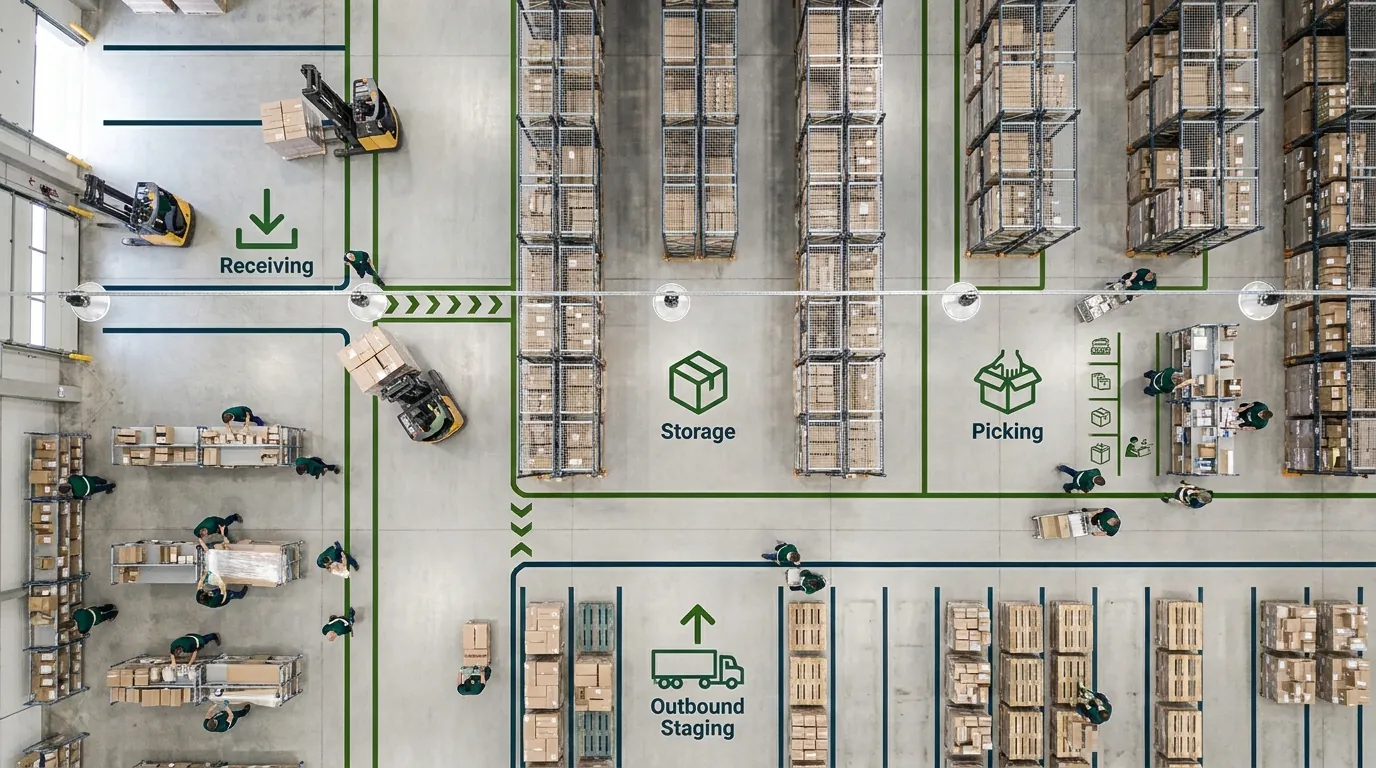
An effective card is complete, unambiguous and tied to measurable activity. Every charge should map to something the warehouse or transportation system records, such as a received pallet, a picked line or a delivered stop. If an activity cannot be measured, it cannot be billed reliably.
Use the lists below to review your current cards. Gaps usually appear in value-added services and accessorials, where work gets performed but no rate was ever defined.
Warehouse Service Components
- Receiving: per pallet, per carton or per container (for example, 20-ft vs 40-ft floor-loaded)
- Storage: per pallet per month, per square foot or per cubic foot; state whether billing is anniversary-based or split-month
- Handling: in/out handling per pallet or case
- Pick/pack: per order, per line and per unit, plus packaging materials
- Value-added services (VAS): kitting, labeling, returns processing and cycle counts, priced per unit or per labor hour
- Minimums: monthly account minimums and minimum charges per order
- Special handling: hazmat, temperature control and oversized items
Freight Pricing Components
- Lane or zone rates: origin-destination pairs or zip-code zones
- Weight breaks: tiered LTL pricing (under 500 lb, 500 to 999 lb, 1,000 to 1,999 lb)
- Mode and equipment: FTL, LTL, dry van, reefer, flatbed
- Fuel surcharge: a percentage or per-mile charge indexed to a published diesel price table
- Accessorials: liftgate, residential delivery, inside delivery, detention, layover, redelivery
- Minimum charge per shipment
- Freight class where applicable, based on the National Motor Freight Classification maintained by NMFTA
Sample Combined Rate Card
Here is how a simple combined schedule might read for a hypothetical mid-size customer:
- Receiving, palletized freight: $6.50 for each pallet
- Storage: $18.00 per pallet per month
- Pick/pack: $2.75 for each order plus $0.40 for each additional unit
- Labeling (VAS): $0.25 per unit
- LTL lane, Dallas to Atlanta, 1,000-1,999 lb: $14.20 per cwt
- Fuel surcharge: a percentage of line-haul, set from the weekly diesel table
- Liftgate delivery: $75.00 per shipment
- Monthly minimum: $1,500 per account
Rates are illustrative only.

How to Build and Maintain Rate Cards Step by Step
Building a card is a pricing exercise; keeping it accurate is an operational discipline. Most revenue leakage comes from cards that were correct on day one and drifted as costs, contracts and fuel prices changed. The five steps below cover both the initial build and the ongoing upkeep.
Steps 1-3: Cost Data, Structure, and Versioning
- Gather cost data. Calculate fully loaded labor cost per hour, facility cost per pallet position, equipment costs, and carrier or fleet costs per mile. Use actual productivity rates, such as cases picked per hour, to convert labor into unit costs, then add your target margin.
- Structure by customer and service. Start from a standard base card, then create customer-specific versions that inherit from it. Keep units of measure consistent so rates can be compared across accounts.
- Set effective dates and versions. Give every rate a start date, an end or review date, and a version number tied to the signed contract. Never overwrite old rates. Archive them so past invoices can be audited.
Steps 4-5: Market Reviews and Customer Communication
- Review fuel and market changes. Update surcharge tables on a fixed schedule, often weekly, against a published index such as the U.S. Energy Information Administration diesel price. Review labor, real estate and carrier costs at least once a year, and write escalation clauses into contracts.
- Communicate updates. Notify customers in writing before new rates take effect, cite the contract clause that allows the change, and confirm the effective date. Clear communication prevents most disputes before the first invoice goes out.
A reporting layer helps here. Comparing billed revenue against recorded activity each month shows which accounts are underpriced, and our piece on business intelligence vs reporting covers how to set that up.
Common Rate Card Mistakes That Leak Revenue
Revenue leakage is the gap between what you earned under contract and what you actually invoiced. It is easy to underestimate because unbilled work never appears on any report. Five mistakes account for most of it, and each is preventable with better process and better systems.
Missed Accessorials and Outdated Fuel Tables
Missed accessorials are the most common leak. Detention, liftgate, redelivery and special handling happen on the road or at the dock, but if drivers and warehouse staff do not record them in a system linked to pricing, they never get billed. At $75 per missed liftgate, ten misses a week adds up to roughly $39,000 a year, from one charge type alone.
Outdated fuel tables are the second leak. If the surcharge is still keyed to last quarter's diesel price during a rising market, every shipment goes out underpriced. The fix is a set update cadence and a system that pulls the current table at the moment of rating rather than whenever someone remembers.
Manual Entry, Version Drift, and Inconsistent Quoting
Manual entry errors creep in whenever billing staff re-key quantities and rates from one system to another. A misplaced decimal or wrong customer code can go unnoticed until the customer spots it.
Contract version drift happens when a renegotiated rate is updated in the contract but not in the billing spreadsheet, or the reverse. Both sides then work from different numbers without knowing it.
Inconsistent quoting occurs when sales, customer service and transportation teams price from different files. The result is quotes that undercut margins or contradict each other, which makes the provider look disorganized to the very customers it wants to keep.
Automating Warehouse and Freight Rate Cards with a WMS
The fix for every mistake above is the same: store pricing in the system where work is recorded, and let that system apply it. A warehouse management system with built-in billing can hold customer-specific storage, handling and transportation pricing next to the receiving, putaway, fulfillment and shipment transactions that trigger each charge. When you compare platforms, ask how closely their rate schedules connect to the activity records your teams already create every day. For background on how these platforms fit together, see our overview of logistics management systems.
Rating at the Transaction Level
When a pallet is received, an order is picked or a shipment is delivered, a WMS can apply the correct customer rate, unit of measure and effective-dated version automatically. Accessorials recorded by operations can flow straight to billing, recurring storage charges can calculate on schedule, and fuel surcharges can reference current tables. When warehousing and transportation share one data set, finance can see total account profitability instead of disconnected pieces.
During an evaluation, test this with a realistic scenario. Walk a sample order through receipt, storage, picking and delivery, add a liftgate and a detention event, and check whether every charge appears on the draft invoice without anyone typing it in.
Faster Quotes and Cleaner Invoices
With one shared reference for pricing, sales and pricing teams quote from identical, current rates, which cuts turnaround time and removes inconsistency. Invoices are generated from recorded activity instead of re-keyed spreadsheets, so each line item traces back to the transaction and contract version behind it. That traceability shortens dispute resolution and helps invoices get paid faster.
Request a Demo to see Argos Software in action.