

What Is Proof of Delivery in Trucking?
A POD in trucking is evidence, signed by the consignee or an authorized agent, that the freight described on the shipping paperwork reached the agreed location. Getting proof of delivery trucking practices right decides how fast you bill, how often you win claims, and how much office time goes into chasing paper. For decades that evidence has been the delivery copy of the bill of lading (BOL), which serves as the contract of carriage between shipper and carrier, signed at the receiving dock. More and more carriers now capture an electronic POD (ePOD) instead: a digital record that combines the signature with photos, GPS coordinates, a timestamp and scanned barcodes.
The document plays the same role across full truckload (FTL, where one shipper's freight fills a trailer), less-than-truckload (LTL, where several shippers share space and freight moves through terminals) and local fleets running multi-stop routes. Volume is what differs. An FTL lane might produce a single POD per day, while a food service or building supply truck could produce twenty before lunch. Every added stop means more paper and more chances for a delivery record to disappear.
What Is the POD Meaning in Business? (Not Print-on-Demand or Payable-on-Death)
A search for POD meaning in business returns three unrelated definitions, so precision matters:
- Proof of delivery: the transportation and logistics sense used throughout this guide. It confirms that goods were received and supports both invoicing and claims.
- Print-on-demand: an e-commerce and publishing model in which books, apparel or similar items are produced only after a customer places an order.
- Payable-on-death: a banking designation naming a beneficiary who receives account funds when the owner dies, without going through probate.
In freight, distribution and warehousing, the acronym nearly always refers to the first definition. When a customer contract, carrier agreement or accounts receivable policy states that invoices require a POD, it means signed evidence of receipt, not a printing service or an estate plan. Spelling this out in contracts and internal SOPs prevents confusion when new hires, auditors or software vendors enter the discussion.
Why Do Paper PODs Cost Trucking Operations Money?
Paper delivery receipts drain money in four predictable areas:
- Slow invoicing: many shippers and brokers refuse to pay until they see a signed POD. When drivers hand in paperwork only at the end of the week, billing stalls and days sales outstanding (DSO), the average number of days it takes to collect receivables, rises.
- Missing paperwork: one lost signed BOL can turn a completed load into an unbillable trip or a write-off.
- Thin claims support: a handwritten note like "2 cs short" with no photo seldom wins an overage, shortage and damage (OS&D) dispute.
- Detention arguments: without recorded arrival and departure times, charging for driver wait time becomes difficult. Industry groups such as the American Transportation Research Institute (ATRI) have studied how detention at shipper and receiver facilities eats into carrier productivity and revenue.
Then there is clerical work. Someone has to sort, scan, index and key data from every sheet that comes back in a cab.

What Role Does Proof of Delivery Play in Logistics?
The POD is the final link in a chain of documents that begins the moment a customer places an order. Each record in that chain answers its own question: what was ordered, what was packed, what was handed to the carrier, and what the consignee actually received. Only the POD answers the last one, which is why it carries so much weight when invoices go out and disputes come in.
People mix these documents up because one physical sheet can play two roles. The signed delivery copy of a bill of lading often doubles as the POD, and a delivery receipt may simply be a carrier's own form. Knowing which is which matters when a customer challenges a charge and you need to produce the correct evidence.
How Is a POD Different From a BOL, Delivery Receipt, and Packing Slip?
Each of the four documents has a different author, timing, purpose and signer:
- Bill of lading (BOL): created by the shipper or carrier when freight is tendered. It serves as the contract of carriage, a receipt for goods and sometimes a document of title. Shipper and carrier sign it at origin, and the consignee signs the delivery copy.
- Packing slip: produced by the shipper's warehouse and placed inside or attached to the shipment. It lists the items and quantities packed for the order and usually carries no signature at all.
- Delivery receipt: a carrier form, common in LTL, completed at the consignee's door. It records the handoff, often with exception notes, and the receiving party signs it.
- POD: generated by the carrier or delivering fleet at and after delivery. It documents receipt, quantity, condition and time, supports invoicing and claims, and bears the signature of the consignee or authorized agent.
The practical takeaway: the BOL shows what left your dock, and the POD shows what arrived. Resolving a shortage requires both. In some industries, condition notes matter as much as counts. Growers shipping live plants, for example, rely on signed exception notes to settle damage claims, a subject the plant nursery software guide covers in more depth.
Where Does POD Sit in the Order-to-Cash Cycle?
The order-to-cash cycle moves from order entry through fulfillment, shipping, delivery, invoicing, and payment. POD acts as the gate between the last two operational steps and billing. Upstream, the warehouse management system (WMS) records what was picked and loaded, while the transportation management system (TMS) or dispatch module tracks the route and driver. Downstream, accounts receivable needs confirmed quantities before it can bill accurately.
When delivery confirmation still depends on paper, every downstream step waits for a driver to turn in a clipboard. When the signed record flows back electronically, with confirmed quantities and exceptions attached, the invoice can reflect what was actually delivered instead of the original order. That one shift cuts down on credit memos, short-pays, and the back-and-forth that drags out collection. An integrated platform can keep dispatch, warehouse, and billing data attached to a single delivery record, so the finance team works from the numbers the consignee signed for.

What Must a Trucking POD Include, and What Types of POD Exist?
A POD is only as useful as the data it holds. A signature proves someone accepted the freight, but it says nothing about quantity, condition, or timing. A complete record gives billing, detention invoicing, and any later claim something solid to stand on.
How you capture that record matters just as much. Paper, mobile ePOD, and contactless capture differ in evidence quality, speed, and how easily the data reaches other systems. Stop volume, customer mandates, and how fast the office needs the information should drive the choice.
Which Fields Belong on Every Trucking POD?
At minimum, a trucking POD should carry:
- Shipper, carrier, and consignee names and addresses
- Bill of lading number, PRO or order number, and customer PO
- Item descriptions, SKUs, and quantities shipped vs. received
- Piece count, pallet count, and weight where relevant
- Seal number and whether it arrived intact
- Arrival time, departure time, and delivery date
- Receiver's printed name and signature
- Exception notes covering shortages, overages, damages, and refusals
- Driver name plus truck and trailer numbers
- For ePOD: GPS coordinates, photos, and barcode scan results
Drivers skip the arrival and departure timestamps more often than anything else, yet those two entries are what justify a detention charge.
Paper vs. ePOD vs. Contactless POD: Which Capture Method Fits?
Compare the three methods on capture, speed, evidence, exception detail, integration and best fit:
- Paper POD: an ink signature on the BOL or delivery receipt. It takes hours to days to reach the office, evidence strength runs low to moderate, exceptions are handwritten, and integration means manual scanning and keying. Keep it for very low volume or as a backup.
- ePOD (mobile app): an on-device signature plus photo, scan, GPS, and timestamp. Data arrives in near real time whenever the device has coverage, evidence is strong, exceptions are coded with photos attached, and records move into WMS, TMS, or ERP through an API or native sync. This suits most fleets and 3PLs.
- Contactless POD: photo, GPS, scan, or a receiver code with no handheld signature. Records land minutes after the device syncs, the evidence holds up well when photos and geofence data are complete, exceptions use the same structured codes, and integration mirrors ePOD. It fits unattended, after-hours, or jobsite drops.
Most operations make ePOD the default, add contactless options for unattended stops, and keep paper as a fallback.
How Should Drivers Record Shortages, Damages, and Refusals?
Free-text notes are hard to report on. Standardized exception codes turn each delivery problem into data you can sort and trend. A practical set includes short (fewer units than the BOL), over, damaged (photo required), refused (reason required), wrong item, and concealed damage reported after the driver leaves.
Picture a refrigerated load to a grocery DC where the receiver rejects one pallet of yogurt because its temperature reading is out of spec. On paper, the driver scribbles "1 plt refused," and the pallet returns to your dock with no context. With codes, the driver selects "refused, temperature," photographs the probe reading and pallet label, and the receiver signs for the accepted quantity. The office sees the exception before the truck leaves the lot.
Any condition-sensitive freight benefits from the same discipline. Nurseries moving live plants, for instance, depend on arrival photos to settle disputes over wilted or broken stock, a theme explored further in this overview of plant nursery management software.
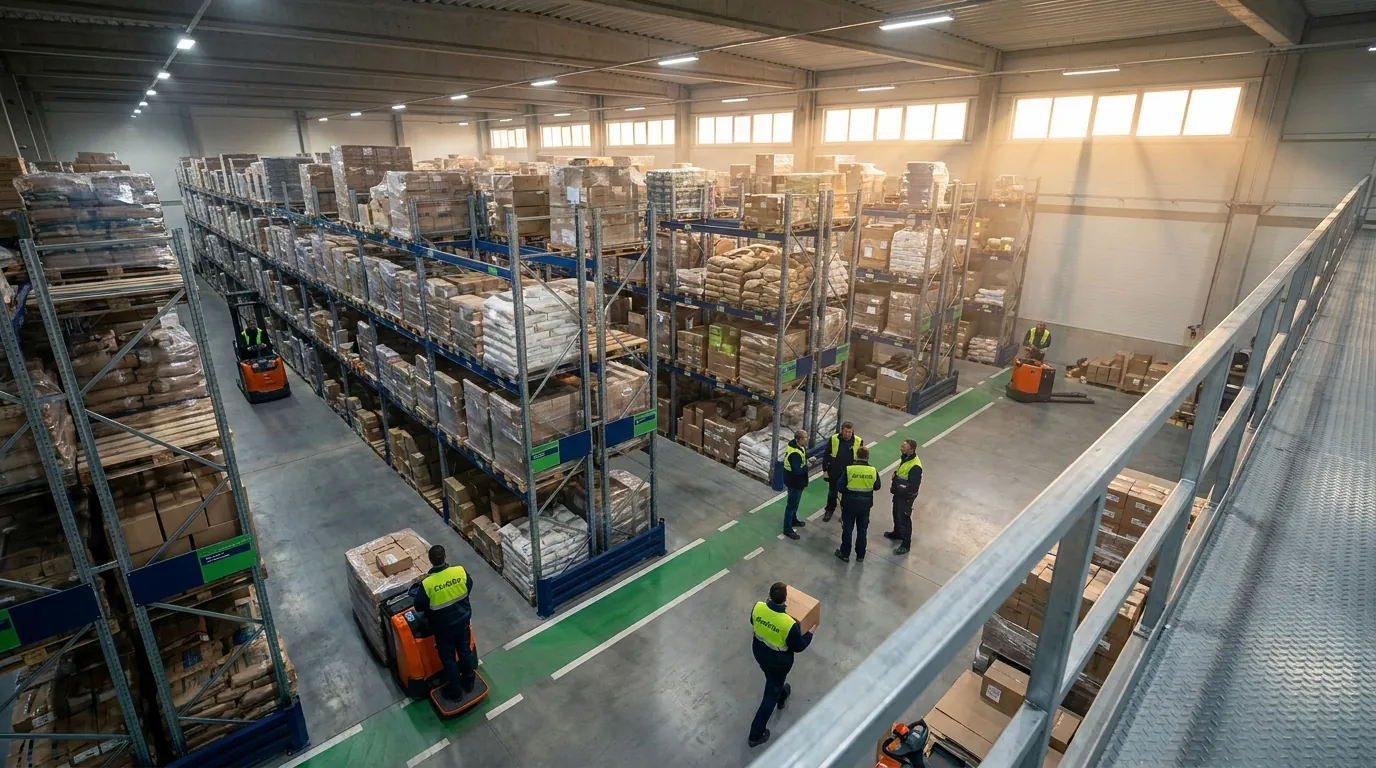
How Does the End-to-End Proof of Delivery Trucking Workflow Work?
The clearest way to see the process is to follow a single load. Picture a building supply distributor sending a mixed shipment of lumber, fasteners, and drywall to a contractor yard, with a second stop at a retail branch. Every step either creates data the POD depends on or uses data the POD produces.
In a disconnected setup, staff retype that information at each handoff. In an integrated one, warehouse, dispatch, and accounting teams share one order record, so the POD simply completes it. Greenhouse growers apply the same logic when they track plants from seeding to shipment, as this look at greenhouse production management software explains.
Step 1: Pick, Pack, Load, and Create the BOL
The POD begins in the warehouse. The WMS directs picking, and handheld scans confirm each item and quantity. Scanning at the dock door verifies what actually went onto the trailer, loaded in stop sequence. The BOL is generated from that verified load rather than the original order, so its quantities reflect reality. If pickers come up two cartons short, the BOL shows it before the truck leaves, heading off a false shortage claim at the customer's site.
Step 2: Dispatch and Route the Load
Dispatch assigns the driver and truck, sequences stops, and pushes the manifest to a mobile device. Each stop lists expected items, quantities, delivery windows, and special instructions such as liftgate needs or receiving hours. Because the manifest arrives electronically, the driver records proof against a known list instead of writing from scratch, and any exception stands out immediately.
Step 3: Capture Proof at the Consignee's Dock
At the contractor yard, GPS and a timestamp log arrival. The driver scans items off the trailer, photographs the unloaded material, and flags one drywall bundle with a crushed corner using a "damaged" exception code plus a photo. The receiver signs for the quantity received with the damage noted, and departure time is captured automatically. Without cell signal, the handheld stores everything offline and syncs once coverage returns.
Step 4: Sync POD Data Back to WMS, TMS, and ERP
After syncing, the POD updates each system that relies on it. The TMS closes the stop with actual times. The WMS logs the crushed drywall as a pending return or credit. In the ERP, the order moves to delivered with verified counts and attached images. Customer service can answer "Did it arrive?" without phoning the driver, and the signed record is searchable by order, BOL, or customer.
Step 5: Trigger Invoicing, OS&D Claims, and Returns Reconciliation
With a delivered status and confirmed quantities in place, billing can issue the invoice the same day, priced on what the customer accepted. The damaged item becomes a credit or replacement order instead of a surprise short-pay weeks later. If the harm happened in a carrier's care, as with a damaged LTL shipment, the photos, signed exception, and timestamps form the core of an OS&D claim. Time-in and time-out stamps also document detention, which can be billed as an accessorial. Returns reconcile against the original exception, keeping inventory and AR aligned.
What Legal, Compliance, and Software Requirements Apply to Trucking POD?
A delivery receipt is useful only if it survives a challenge from a shipper, a carrier, or an auditor. Three questions decide that: whether an electronic signature counts, how long the paperwork must stay on file, and which claim deadlines apply. The capture tool matters too, because it determines whether the record can be defended in the first place.
Treat what follows as general information, not legal advice. Contract terms, tariffs, and state law differ, so confirm the details with counsel.
Are Electronic Signatures Legally Valid on a POD?
In most U.S. commercial settings, yes. The federal Electronic Signatures in Global and National Commerce Act (ESIGN, 2000) says a signature or record cannot be denied legal effect simply because it exists in electronic form. The Uniform Electronic Transactions Act (UETA), adopted in nearly every state, applies the same rule under state law.
What makes a signature hold up is the evidence around it: who signed, at what time, at which location, and against which document. Picture two disputed shortages. In one, the carrier produces a smudged carbon copy with an illegible scrawl. In the other, it shows a signature linked to a printed receiver name, a timestamp, GPS coordinates, and an unaltered copy of the delivery record. The second is much easier to defend.
How Long Should You Keep PODs, and What Are Carrier Claim Deadlines?
FMCSA rules at 49 CFR Part 379 set minimum retention periods for motor carrier records, including bills of lading and delivery receipts. Tax rules, audits, and customer contracts frequently require longer, so many fleets hold PODs for several years. Digital archives keep that cost low and make retrieval quick.
For interstate loss and damage, the Carmack Amendment (49 U.S.C. 14706) lets carriers set a claim filing deadline of no less than 9 months after delivery, and a lawsuit deadline of at least 2 years from a written claim denial. Under 49 CFR Part 370, the carrier must acknowledge a claim within 30 days and generally pay, decline, or make a compromise offer within 120 days. Precise exception notes on the receipt are your best evidence during those windows. Shippers of perishable goods feel this pressure as well. Growers tracking outbound plant orders face similar documentation demands, a point raised in this look at greenhouse management software.
What Features Should Trucking ePOD Software Have?
Use this in-page checklist when comparing ePOD tools:
- Offline mode: capture and store PODs without a signal, then sync automatically
- Configurable exception codes: short, over, damaged, refused, with required photos
- Barcode and item-level scanning: verify each drop against the manifest
- GPS and timestamp capture: arrival, departure, and signature location for detention and disputes
- Multi-stop route support: stop sequencing and partial deliveries
- Native WMS/TMS/ERP integration or open API: no re-keying
- Automatic invoice trigger: a delivered status releases billing
- Searchable document storage: retrieval by BOL, order, PO, or customer
- Customer-facing access: POD copies emailed on completion
- Audit trail: a tamper-evident log of who captured or edited each record
A tool missing several of these items will leave gaps that surface later in disputes or billing. When you score options, weight offline capture and integration most heavily, since those two determine whether records arrive complete and whether anyone has to retype them.
How Can a WMS Connect POD, Warehouse, and Accounting Data?
When warehouse, transportation, and accounting functions share a database, the delivery record stops being a file parked in a separate app. A WMS built that way can treat the signed receipt as the status change that closes out an order the warehouse, dispatch, and billing staff already know about.
Consider a food distributor, a building supply yard, an ag supplier, or a wholesaler running its own fleet. In a connected setup, the cases scanned at the dock, the stop sequence built in dispatch, and the shortages or damage a customer signs for at the door can all sit on one order record. Invoices, credit memos, and freight claims can then pull from that record directly, so nobody has to reconstruct a delivery from paper and memory.
Here is a hypothetical day. A picker confirms 40 cases of frozen product against a route. The dispatcher sees the confirmed quantity, not the ordered quantity, when building the manifest. At the third stop, the receiver refuses two cases that thawed in transit, and the driver records the refusal with a photo and a signature. By the time the truck returns, the order already shows 38 delivered and two refused, and the billing clerk is working from accurate numbers.
When you evaluate a platform, trace one order from pick confirmation to paid invoice and count the times a person has to copy data from one screen to another. Each copy is a place where counts drift and timing slips. A system worth shortlisting should let a refused case show up as a credit without anyone rekeying it.
Why Does One Shared Record Beat a Standalone ePOD App?
Standalone ePOD apps handle capture well, but they tend to shift the bottleneck to integration. Someone still exports the day's files, matches each one to an order number, and types delivered quantities into the accounting package. Every handoff adds delay. Every manual entry is a chance to bill for product that never reached the customer, or to miss a shortage until the customer short-pays.
A shared record removes those handoffs. The load confirmed in the WMS generates the bill of lading. Dispatch pushes the manifest to the driver's device. The driver's POD updates the order in place, and accounting invoices what actually arrived rather than what was planned. Exceptions turn into credits or claims as part of the same transaction, instead of surfacing weeks later as unexplained balances in the aging report.
For fleets that deliver their own freight, that is the practical gap between digitizing a paper form and connecting the business process wrapped around it. A digital signature by itself shows that a truck showed up. Tied to warehouse counts and open receivables, it also tells finance exactly what to bill, what to credit, and what to pursue with the carrier or insurer. Request a Demo to see Argos Software in action.